


Why You Procrastinate, Based on Your DiSC Style (and How to Move Forward)

We all procrastinate, but the reasons behind it vary. Understanding your procrastination tendencies and triggers can help you break unhelpful cycles. Relying on force of will is rarely successful in the long term. It’s important to align your anti-procrastination approach to your natural motivations. This article explores the role that personality style plays in procrastination and provides strategies for each DiSC® style to stop putting things off.
Key Takeaways
- Procrastination is usually an emotional regulation issue, rather than strictly a time management problem or lack of discipline.
- Understanding the six procrastination types and the procrastination triggers of each DiSC style helps you craft a strategy that works for you.
- For example, D-style people often procrastinate from resistance or boredom, i types because novelty wanes, S-style folks because of decision paralysis, and C-style individuals due to perfectionism.
What is procrastination?
Procrastination is the act of putting off tasks. Or, more formally, “an irrational tendency to delay required tasks or assignments despite the negative effects of this postponement on the individuals and organizations” (Yan and Zhang, 2022). It’s irrational, it brings negative consequences, and more than 95% of procrastinators wish they didn’t procrastinate so much. So why do we do it?
Scientific research shows that procrastination is a complex practice that differs from laziness or lack of willpower. It is a self-defeating habit deeply tied to emotional regulation, motivation, and cognitive patterns. Studies estimate that about 15–20% of adults are chronic procrastinators, struggling regularly to start or complete tasks, while many others procrastinate occasionally depending on the situation.
Procrastination is more likely to be an emotional management issue than a time management issue (Sirois and Pychyl, 2013). People often procrastinate to avoid negative emotions associated with a task, such as boredom or self-doubt.
Personality style plays a significant role in how and why people procrastinate, influencing their typical triggers and responses to tasks. However, procrastination is also affected by factors like stress, mental and physical health, and one’s environment. Task completion requires a certain amount of executive functioning, and many internal and external factors can sap this.
This complexity means overcoming procrastination requires more than just discipline—it demands understanding your behavioral tendencies and mood regulation. There’s not a simple fix, but when you work with your personality type, you can discover ways to chip away at stubborn procrastination habits.
Six styles of procrastination
Dr. Linda Sapadin outlines six types of procrastinators in her books How to Beat Procrastination in the Digital Age and It's About Time!: The Six Styles of Procrastination and How to Overcome Them.
We likely all operate from all these styles at some point, just as we call upon different DiSC styles at different times. These are not the only six reasons people procrastinate, but learning about these styles illustrates that people engage in this behavior for disparate reasons, so their approach to fighting the habit needs to look different as well.
Sapadin does not use the DiSC model. The style connections below are what I suggest as someone who has worked with Everything DiSC® for many years.
The Perfectionist
Perfectionists delay because they fear making mistakes. Perfectionists:
- have unrealistically high standards for themselves
- think that others have the same standards for them
- find that even if they begin a task, they often delay its completion, endlessly revising and overthinking (procrastination via overworking)
DiSC styles which may lean toward perfectionist procrastination tendencies: C, CS, SC, sometimes S
The Dreamer
Dreamers procrastinate because they have big ideas but struggle with execution and practicalities. Dreamers:
- are easily deterred by obstacles
- prefer to dwell in the ideating/dreaming/planning/fantasizing stage
- may unconsciously be hoping for a lucky break or external actor that will exempt them from the usual methods (details, grit, problem-solving, hard work…)
DiSC styles which may have dreamer procrastination tendencies: i, iD
The Worrier
Worriers procrastinate because they fear risk, uncertainty, change, and consequences. Worriers:
- have a great need for security and obsess about the “what ifs”
- overanalyze or delay decisions, seeking reassurance before they start.
- put off initiating tasks due to anxiety, self-doubt, or fear of disappointing others
- drag out projects because finishing them means moving on to new territory
DiSC styles which may tend toward worrier procrastination tendencies: S, Si, SC, sometimes C
The Defier
Defiers put things off as a method of resistance when they feel forced, controlled, or constrained. Defiers:
- sometimes delay as a way to rebel against the expectations of others
- at other times drag their feet in a more passive-aggressive way, especially if the task was assigned to them
- have a great need for autonomy and may delay until they can figure out how to feel they are in control
DiSC styles which may have defier procrastination tendencies: D, DC, CD
The Crisis-Maker
Crisis-makers rely on pressure, urgency, or last-minute adrenaline to get motivated. Crisis-makers:
- often wait until right before a deadline to start working
- feel energized by urgency and may believe they work best under “crunch time”
- think planning early is pointless — they trust pressure will prompt action
DiSC styles which may have crisis-maker procrastination tendencies: D, Di, i
The Overdoer
Overdoers delay because they take on too much, leading to procrastination by overload. Overdoers:
- say “yes” to too many commitments because they’re “unable—or unwilling—to make choices and establish priorities” (Sarapin, It’s About Time!, pg. 14)
- fail to take action due to overwhelm and fatigue
- tend to manage time inefficiently and struggle to stay organized
DiSC styles which may have overdoer procrastination tendencies: S, Si, iS, i
DiSC types and procrastination
The reasons each DiSC style procrastinates and the methods to fight it tie closely to what motivates and demotivates that style.

D style: results-oriented, fast-paced
People with D styles can power through a to-do list quickly and with focus — when the tasks align with their motivations. However, if they lack autonomy, don’t see the point of a task, think it will be slow, or suspect they won’t be good at it, they can drag their feet as well as any style.
A friend who has a strong D style explains his procrastination patterns with the phrase, “I only play games I know I can win.” When faced with work or a bit of life admin in an area where he doesn’t think he’ll excel, he’ll delay as much as possible. (Especially if the task is something delegated to him, or demands he follow a process he thinks is foolish.)
Why people with D styles may procrastinate
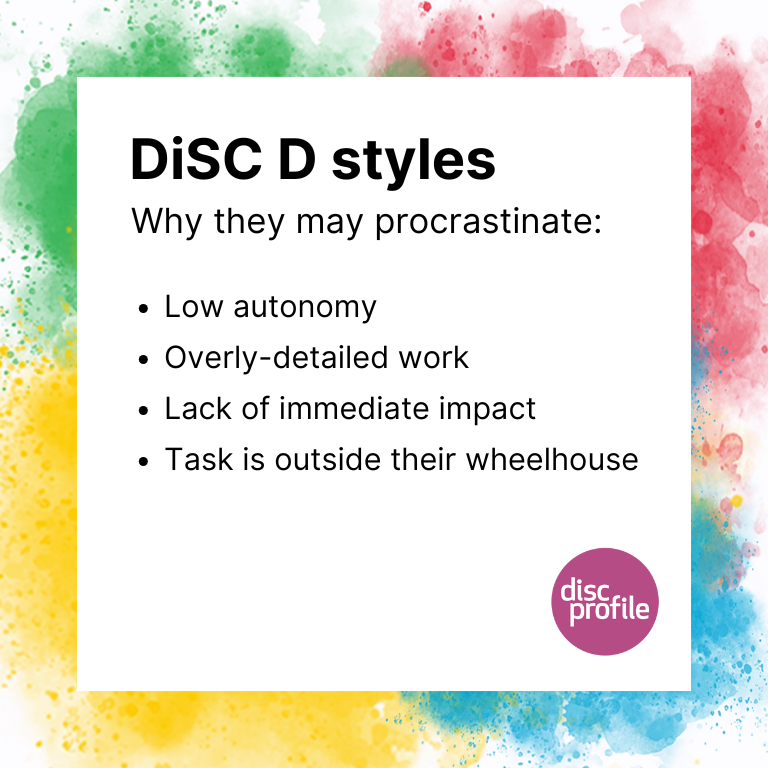
- Low autonomy: If someone else is deciding what work they should do (and how and when), a person with D tendencies can go into Defier mode. They procrastinate as a way to resist the lack of control over their own time.
- Overly-detailed work: D types like to make quick progress. If the project is slow and finicky, the motivation is just not there. They’ll find other, more exciting work to do first.
- Lack of immediate impact: Goal-oriented D-style folks have little patience for “laying the groundwork” type tasks where the pay-off is far into the future.
- Outside their wheelhouse: Like my friend mentioned above, people with D personalities like to win. If the task requires a skill set they’re not confident they have, they are apt to avoid it.
Procrastination-busting strategies for D-type personalities
Increase autonomy
Instead of focusing on which parts of a project you don’t control, find spaces within the project to make your own decisions. Can you break the project down in the steps most interesting to you, or use your preferred method to get the needed result?
Use challenge-based motivation
Gamify your tedium! How quickly can you get through the spreadsheet without mistakes? Can you do it faster than you did last month? Maybe you challenge yourself to clear your inbox before a certain time. Think of ways to set up winnable challenges throughout your duller days, and don’t forget to celebrate when you win.
Clarify the why
Write down: “If I do this now, the result I create is _____.” This helps you understand the impact.
Apply structured urgency
Waiting until the last minute to race through a task can be exciting and make you less likely to overthink something. However, it can also lead to burnout, errors, and stress for your steadier colleagues.
Structured urgency is a strategy that gives your brain the feeling of a deadline without relying on real last-minute pressure. You can create it using methods such as: artificial mini-deadlines, time-boxing, telling someone you’ll deliver a draft by a certain time, setting countdown timers, and creating micro-goals.
Remember: D-style individuals are motivated by making an impact, being in charge, advancement, and competition
i style: sociable, enthusiastic, idea-driven
With all that energy, i-type personalities can get a ton accomplished when the work is exciting. They may struggle to complete work that is boring, repetitive, or intimidatingly complex. Other procrastination triggers for i styles include having too many ideas at once and facing tasks that lack a social element.
Why people with i styles may procrastinate
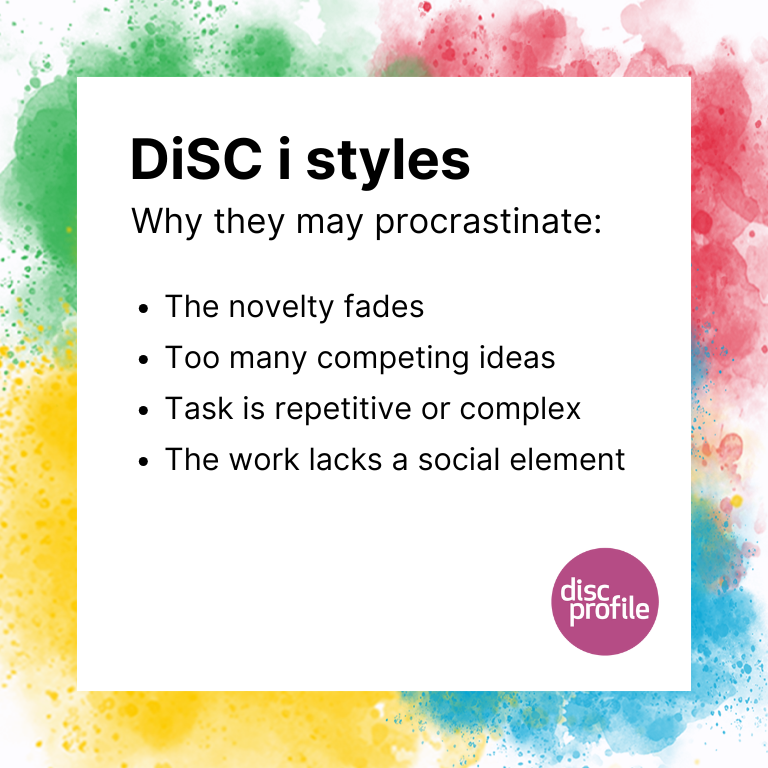
- The novelty fades: People with i-type personalities usually start more than they finish. They like the initial phase, when the idea is new, but can struggle to see things through to completion.
- Too many competing ideas: They have a lot of ideas of their own and they tend to say “yes” to others’ requests before thinking through whether they have time for the work.
- Dependence on social energy: Sociable i-styles get energy from interacting with others, and isolating work is demotivating for them.
Procrastination-busting strategies for i-type personalities
Let your flair fly
Not every task in your life will be a fun one. But there are often ways to cultivate a playful mindset while still making progress.
- Make tasks, goals, and especially progress visible. And colorful! Use sticky notes, whiteboards, or creative checklists.
- Reward yourself with something fun when a milestone is complete.
Chunk your time
Many people with i-style tendencies find it difficult to structure their time efficiently. Try these approaches to add structure without feeling deflated by routine:
- Work in sprints of 15 to 20 minutes to maintain your dopamine-driven motivation.
- Break tasks into energizing micro-milestones.
- Create templates for regular tasks so you can get through them and back to more creative work
- Commit to a 10-minute ignition. It’s often hard to start, but once you have put in 10 minutes, momentum kicks in.
Add social energy
Have you heard about Life Admin Parties, Admin Nights, or Forcing Parties? The idea is that a group of friends gather to complete bureaucratic tasks they’ve been putting off, like doing taxes or finding a new insurance policy. By making dreaded paperwork a social event, it connects people — and the tasks actually get done! I heard about these parties from Priya Parker, who regularly shares ideas for unique gatherings that i types might like.
You don’t have to throw a party every time you’re procrastinating a boring task, but you can find ways to bring social energy to projects. One example is to use accountability partners who can keep you focused and celebrate the small wins with you.
Remember: i-style individuals are motivated by enthusiasm, novelty, positivity, social recognition, and relationships.
S style: supportive, steady, relationship-focused
S-style individuals value being someone others can count on and feel a strong commitment to delivering on their promises. Their steady personalities mean they can stick with tasks even after the excitement wears off. But of course, S types can drag their feet as well as any style when they encounter an S-style procrastination trigger: fear of letting others down, uncertainty, or too many requests.
To fight procrastination, S-style people need to build confidence and reduce overwhelm.
Why people with S styles may procrastinate
- Decision anxiety: When facing uncertainty, S-style personalities want reassurance. There’s a lot of overlap with the Worrier procrastinator style discussed above. Even decisions that seem non-consequential to other personalities can cause stress for S types.
- Unclear expectations: They may delay starting a task if they lack clarity about the desired outcome or process. And, not wanting to bother anyone, they may fail to speak up and request this clarity.
- Fear of letting others down: Other personalities may be able to move through a task by trusting their instincts and talents. If they’re happy with the result, they’re less concerned what others think. This mindset is harder for S-style people, who tend to overestimate the competencies of others and underestimate their own.
- Overwhelm from supporting everyone: If there’s a person on your team who has an accommodating personality and thus ends up volunteering to help everyone else (or being the one everyone dumps their work on), check their DiSC profile. I have a guess.
Procrastination-busting strategies for S-type personalities
Time-box your decisions
Without boundaries, S styles can ruminate on decisions almost indefinitely. Try setting a deadline that fits your comfort zone: I’ll choose by 2 p.m. today, or I’ll share my decision Friday morning. Other decision-making helpers:
- Adopt a “good enough to move forward” rule, especially for routine or low-stakes decisions.
- Break the decision into smaller steps. Just pick the next action, not the whole thing.
- Develop a realistic view of the stakes, which are usually not actually as high as they feel.
- Use trial runs to reduce fear of making the wrong choice. Let me try this for two weeks and reassess.
Get clarity early
Don’t wait to ask for the information you need to move forward. That information might not be available for every project, but you don’t know without asking. Clarity makes it easier to begin.
Likewise, ask for feedback early. Small, regular pulse checks can feel safer than one final judgment at the project’s end.
Practice boundary-setting
I have an S style, so I know this can be hard! I try to remind myself that saying no to requests when my plate is full will actually help me achieve my goal of not letting anyone down. When I say yes to too much, I either get overwhelmed and put all of it off, or I do every task a little worse than I would have with less work. Either of those outcomes feels bad and like I am letting people down. Better to tell people up front that I can’t take the project on.
Another phrase I’m working on is “Yes, after…”. When a request comes in, I use my orientation toward service as an excuse to stop the difficult thing I’m working on and switch to the requested task. But this breaks my focus and can pull me from higher-priority work. “Yes, after…” allows me to maintain harmony while protecting my focus.
Remember: S-style individuals are motivated by helping others, collaboration, relationships, and stability.

C style: analytical, conscientious, accuracy-focused
C styles aim for excellence. They want to be seen as competent at a minimum, but preferably as experts. People with C-type personalities also enjoy digging into the details of complex issues, but can get stuck down the rabbit hole. They often delay starting because they want more data, more proof, or perfect conditions. Or, the task involves skills they don’t feel they have mastery of, and they are afraid of making errors.
A C personality’s kryptonite is overthinking. Or maybe perfectionism. Making progress will mean grappling with those fearsome foes.
Why people with C styles may procrastinate
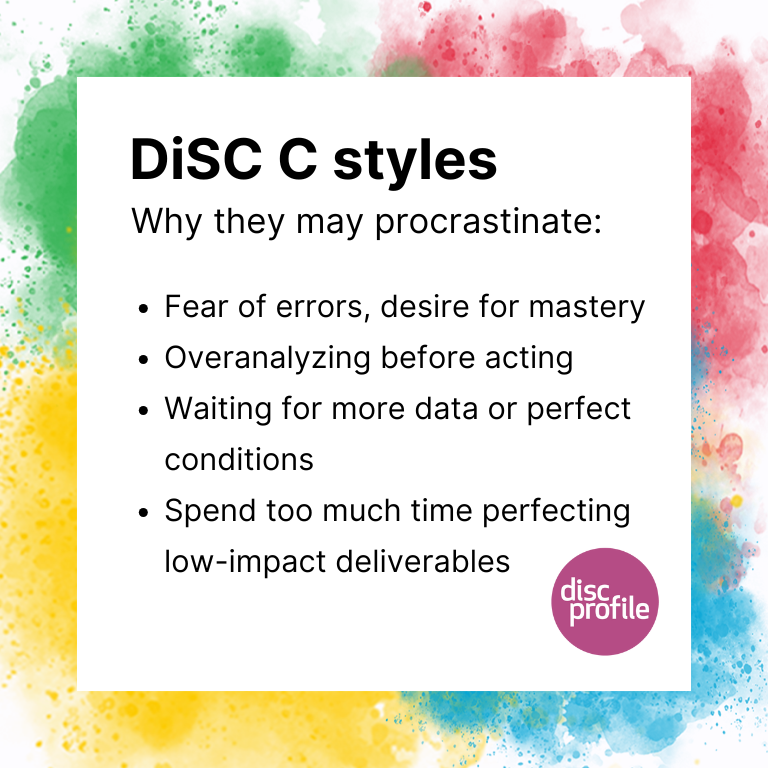
- Perfectionism and fear of errors: The C-type individual’s aversion to making mistakes is generally greater than other personality styles.
- Desire for all the information and perfect conditions first: “I’ll start when I have all the information I need,” say C types. That day rarely comes.
- Overanalyzing before acting: To make progress on complex projects, you often just need to start somewhere. Start messy and clean it up later. It’s difficult for C-style people to work that way. They want to think through all angles before taking the first step.
Procrastination-busting strategies for C-type personalities
Allow yourself a messy first draft or zero draft
You don’t have to show it to anyone, and you don’t have to use this method every time. But experiment with starting before you feel ready. I coach literary writers, and I have seen the benefits of a “zero draft” mindset:
- Clarify your thinking. As my grad school advisor told me, “Writing is thinking.” As E.M. Forster said (approximately), “How do I know what I think until I see what I say?”
- Identify research/information gaps. A zero draft shows where your research time is needed, so you’re not over-researching other areas.
- Get you started fast. A messy first draft breaks the all-or-nothing mindset by making “imperfect progress” not just acceptable, but the goal.
Time-box your information-gathering windows
I have an SC style, and my C tendencies are strong when it’s time to write. I love research, and am motivated by learning new things. I am also a perfectionist who knows that whatever I write won’t measure up to the ideal piece living in my head. Staying in research mode feels safer.
Setting a time limit for the info-gathering phase can help. When that timer goes off, it’s not going to feel like it was enough time. Try to move on anyway.
Get comfortable with “good enough” for low-impact details
It pains my C side to type this, but not every task is worth perfecting. Your “good enough” is likely at a higher standard than most other people’s. And when you refrain from putting finishing touches on a low-impact project, you have more time to apply your high standards to something that matters more.
Remember: C-style individuals are motivated by gaining knowledge and expertise, independence, creating order out of systems, and problem-solving.
Summary: Your anti-procrastination action plan
Fighting procrastination involves more than willpower. You must understand the emotions driving your delay. And to build new habits, tap into the specific motivators of your personality type.
DiSC D-style people often procrastinate from resistance or boredom. Anti-procrastination methods include creating challenges for themselves and locating spaces of control.
People with i styles can procrastinate when novelty wanes or when tasks lack social interaction or creativity. It can help to chunk time in ways that will keep energy high and add social elements to routine tasks.
S types may delay because they want to make the right decision and avoid conflict. They’ll keep things moving by setting a time limit on decisions and setting boundaries.
DiSC C-style individuals get slowed down by their high standards and desire for all the information before starting. They may benefit from identifying which tasks can just be good enough and using first drafts as a way to gain clarity.
Posted 12/14/2025


