


How to Evaluate a Training Program: A guide for facilitators
Key Takeaways
- Measure learning, not just satisfaction. Effective evaluations reveal what participants learned and how confident they feel applying new skills.
- Align questions with your objectives.
- Use feedback to improve future sessions. Look for patterns in participant responses to refine your trainings.
Why training evaluations matter
You may have spent hours developing and practicing your training program, but you also need to devote some time and effort to how you will evaluate the results of your training. Evaluations can help you:
- Improve your skills as a facilitator.
- Understand what learners actually gained during the session.
- Increase learner engagement.
- Uncover content or delivery problems.
- Identify opportunities for additional training.
- Appear in a positive light by letting learners know you care about their experience and your performance.
- Gather data to justify the expense of training to stakeholders.
Evaluations require three major actions: deciding what you’re going to measure, measuring it, then adjusting the product based on the results.
The most useful evaluations go beyond asking whether participants enjoyed the experience. They help you answer bigger questions:
- Did participants achieve the learning objectives?
- Do they feel confident applying what they learned?
- What aspects of the training had the greatest impact?
- What should be changed next time?
When evaluations are designed with these questions in mind, they become a valuable tool for continuous improvement—not just another end-of-session survey.
Start with clear learning objectives
Before creating an evaluation form, define what success looks like. If you did even a quick needs assessment, you can use this to guide your evaluation.
Every training session should have a small number of clear learning objectives. Your evaluation should measure whether participants believe they achieved those objectives.
For example, if you're facilitating an Everything DiSC Workplace® session, your objectives might include helping participants:
- Understand their own DiSC® style
- Recognize the priorities and tendencies of other styles
- Adapt their communication to work more effectively with colleagues
Your evaluation questions should directly connect to these outcomes. Rather than asking only whether participants "liked the workshop," ask whether they can actually apply what they learned.
This approach also makes it easier to demonstrate training effectiveness to stakeholders who want evidence that the program produced meaningful results.
Five areas every training evaluation should measure
The strongest evaluations gather feedback in several different categories. Together, they provide a complete picture of the participant experience and the effectiveness of the training.
1. Achievement of learning objectives
This is the most important section of your evaluation. It measures whether participants believe they learned what the training was designed to teach.
Ask learners to rate their learning with items such as:
- I understand the key concepts presented during this workshop (then as a sub-item have a rating scale for each of the key concepts).
- I feel confident applying what I learned.
- This training improved my understanding of [your main objectives, such as "communicating with people different from me"].
If your workshop has specific objectives, include one question for each objective.
2. Training content
Next, evaluate the quality and relevance of the material itself.
Good content should be organized, practical, and relevant to participants' work.
Consider items like:
- The content was relevant to my role.
- The examples helped me understand the concepts.
- The activities reinforced the learning.
- The amount of material was appropriate for the time available.
These questions help identify where content may need to be updated, expanded, or simplified.
3. Facilitator effectiveness
Participants often distinguish between great content and great facilitation. Even excellent material can fall flat without an engaging facilitator. On the flip side, a charismatic facilitator can deliver a fun training where little concrete learning happens.
Evaluate areas such as:
- Clarity of explanations of key concepts
- Ability to answer questions
- Encouragement of participation
- Effective use of activities and discussion
Remember that facilitator evaluations should be viewed as opportunities for growth rather than personal judgments. Looking for patterns across multiple sessions often provides more useful insights than focusing on isolated comments.
4. Learning environment and logistics
Practical issues can influence the overall learning experience. Not all aspects of the learning environment will be under your control. Focus on what you have the ability to change.
Depending on your delivery format, consider evaluating:
- Room setup
- Technology used
- Breaks and schedule
- Handouts or other materials
Some logistical concerns can be low-hanging fruit—easy ways for you to boost participant satisfaction.
5. Future application and impact
One of the most valuable questions isn't about the session itself—it's about what happens afterward.
Ask participants whether they expect to use what they've learned and what support they may need to continue developing.
Questions in this category help organizations understand whether learning is likely to transfer back to the workplace and can identify opportunities for follow-up coaching, reinforcement activities, or additional training.
Read more: Keeping DiSC in Learners' Minds
Sample evaluation questions for DiSC trainings
We’ve offered many more questions than you’ll want to use in a single evaluation form. Keep yours as short as it can be to still be meaningful. If you won’t take action based on a question’s result or the result won’t show the value of your training, then don’t ask the question.
Consider testing your questions by sharing them with another trainer or the sponsor of the training. This can help you catch typos and confusing language.
Evaluate learning objectives
- I understand how the DiSC styles of my teammates affect how they communicate with me.
- I gained insights into how to effectively respond to the style priorities of my teammates.
- I find it easier to explain how to more effectively communicate with me.
- I believe that I will respond to teammates better in the future.
- I believe team discussions will be more fruitful in the future.
- I better understand how to effectively communicate with our team leader.
- I discovered a few reasons why our team has had communication problems in the past.
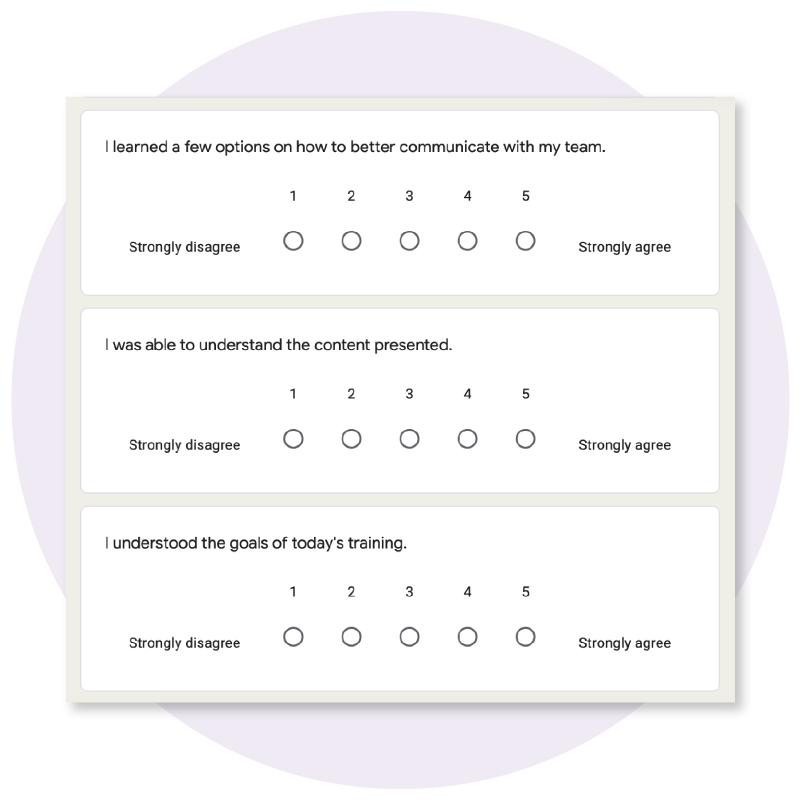
- I learned a few options on how to better communicate with my team.
- I can confidently use people-reading skills to help me communicate with the people our team serves.
Evaluate content
- I was able to understand the content presented.
- I believe that I will use the content of today’s training in the future.
- The videos added to my understanding.
- Time spent in small group discussions helped me better understand how I can apply the concepts introduced.
- Getting my profile report in advance prepared me for our first session.
- The content sparked my curiosity to learn more.
- I’m eager to put today’s training to use.
- The content was new to me.
- The content was relevant to my needs (or the needs of the group).
- This training was worth my time.
Evaluate facilitator performance
- I understood why I was asked to take the assessment or finish the pre-work assignment(s).
- I understood the goals of today’s training.
- I felt heard during training. I felt able to ask questions and to speak up.
- The course was paced appropriately for me.
- The trainer was well-informed about the content.
- The trainer understood how to use their technology.
- The trainer helped us gain insights into the content (or concepts or procedures) covered.
- The trainer made the session engaging.
Evaluate logistics
- The physical space (e.g., lighting, seating, room setup) supported my learning.
- The virtual learning environment (e.g., platform, breakout rooms, audio/video quality) supported my learning.
- The day and time of the training were convenient for me.
- The length of the training was appropriate.
- The technology used during the training (e.g., slides, videos, virtual platform, closed captioning) enhanced my learning experience.
Also consider asking:
- What could be done to make this training easier for you to participate in?
- Were there any barriers to learning that you had to overcome in this training?
Evaluate future impact
- Would you recommend this training to a new team member or colleague?
- How impactful will this workshop be on your work in the next 3 months?
- What would need to be changed before you would recommend this training to others?
- What will you share with others about this training?
- Would you like to receive a refresher training in six months?
- Would you like to receive more in-depth training in the future?
- Do you need anything more to help you apply your learning?
- How do you feel the learning will benefit you and your team?
- Can I contact you in two weeks to ask how you’ve applied your learning?
- Would you like to receive follow-up newsletters (or emails, reminders, etc.) about this content?
Making the most of evaluation results
Collecting feedback is only the first step. The real value comes from using it to improve future sessions.
Rather than reacting to every individual comment, look for recurring themes across multiple workshops. If several participants mention that an activity felt rushed, that may indicate you need additional time or clearer instructions. If participants consistently report that they lack confidence applying a concept after the workshop, consider adding more practice opportunities or real-world examples.
It's also important to balance quantitative and qualitative feedback. Rating scales can reveal trends over time, while open-ended comments often explain why participants responded the way they did.
Finally, share what you've learned. If you're delivering training for an organization, summarize evaluation results for stakeholders and highlight both successes and planned improvements. Demonstrating that you actively use participant feedback builds credibility and shows a commitment to continuous improvement.
Evaluations can be a good source of testimonials or of showing your value to potential clients. Receive a great set of evaluations? Share those with your client and then ask for a recommendation on LinkedIn. If you’re going to use your evaluations in this way, consider asking more open-ended questions to elicit answers worth sharing.
Beware of relying on your own sense of how well a training went. Your comfort or enjoyment might indicate that it went well, but it’s also possible that no real learning occurred. A good evaluation is an essential tool to use for your own learning and success.
The best facilitators don't strive for perfect evaluation scores. They use every training session as an opportunity to learn, refine their approach, and create an even better experience for the next group of participants.
Posted 11/24/2020, Last Updated 07/29/2026


