



3-Minute Meeting Energizers: Microbreak ideas for your next training

Key Takeaways
- Microbreaks can help restore energy during training sessions or long meetings.
- Meeting energizers are short activities that give participants a chance to move, reset, interact, and reengage.
- Meeting energizers can be creative, physical, conversational, or game-based. Here are 40+ energizer ideas.
If you’ve led a meeting or training session—if you’ve attended one—you likely know that feeling of waning energy. It’s common for groups to lose focus as a session progresses. It’s not realistic to expect 100% engagement for a sustained period. That’s not how our brains work. Both facilitators and participants benefit from regular energizing microbreaks.
What is a meeting energizer?
A meeting energizer is a short, interactive activity designed to boost participants’ energy, refocus their attention, and encourage engagement during a meeting or training session.
Energizers can involve physical movement, conversation, games, or creative challenges. They’re typically used when energy starts to dip, after a long stretch of instruction, or when a group needs a mental reset. We recommend using meeting energizers proactively: plan for frequent breaks rather than waiting until the group really needs them.
What is a microbreak?
A microbreak is a brief, informal pause in work or learning, typically lasting anywhere from a few seconds to a few minutes. Microbreaks can give people a chance to move around, rest, or mentally reset before returning to what they were doing. In meetings and training sessions, microbreaks can help reduce fatigue, restore energy, and support sustained attention.
Microbreaks vs. meeting energizers
A microbreak is the short pause itself, while an energizer is a specific activity designed to reengage participants. An energizer can serve as a microbreak, but not all microbreaks involve group activities. As a facilitator, you can use both. Alternate group energizers with independent microbreaks where people have a few minutes to reset or reenergize however they’d like.
Microbreaks are not a substitute for real breaks
Whether you’re using microbreaks as a facilitator or in your day-to-day independent work, remember that longer breaks are still important. Two minutes of stretching is a great idea, but it probably can’t refill an empty tank, especially when you’re engaging in demanding tasks that require top performance.
What are the benefits of meeting energizers?
Meeting energizers do more than add a little fun to a training session. When used thoughtfully, these short activities can help participants reset their attention and connect with one another. They also give facilitators a way to break up long stretches of instruction and respond when the group's energy starts to fade.
Energizers can:
- Restore energy and reduce fatigue. Brief activities give participants a mental and physical break from sitting, listening, and concentrating. Even a few minutes of movement or interaction can help people feel refreshed.
- Refocus attention. Switching gears gives participants a chance to step away from a topic before returning with renewed attention. Energizers can be especially useful between longer sections of content.
- Increase participation. Quick, low-pressure activities invite people to contribute rather than remain passive listeners. They can make it easier for quieter participants to join in.
- Build connections. Activities that encourage conversation, collaboration, or a little friendly competition help participants get to know one another and strengthen group rapport.
- Encourage creativity. A change of pace can help people approach problems from a different perspective. Playful challenges and brainstorming activities can get ideas flowing.
- Improve the learning experience. Breaking up instruction with opportunities to move, talk, and reflect creates variety and gives participants more ways to engage with the material.
40+ meeting energizer ideas
You can plan out which training energizers you’ll use, or be ready with a list of options and choose one based on the vibe of the group.
Movement-based energizers
When introducing these, invite people to join in whatever way feels right for their particular body on this particular day. There are many reasons a person’s movement options may be limited. In addition, people may feel self-conscious and want to turn their cameras off – you can decide what your recommendation will be for your group.
- Shake it out.
- Option 1: Let people get up and shake their bodies however they want for two minutes.
- Option 2: Lead a guided shake-out: shake your right arm, now shake your right leg, etc.
- Option 3: Have everyone shake each limb eight times, then each limb four times, then two, then one (via SessionLab).
- Stretch it out.
- Option 1: Participants stretch on their own
- Option 2: The facilitator leads a group stretching session, focusing on muscles that can get sore after sitting.
- Option 3: The facilitator asks each participant to recommend or demonstrate their favorite stretch, then everyone does it together
- Yoga or qigong. It’s easy to find videos suggesting short routines.
- Get the heart rate up. Pick four or five cardio-ish movements and do each for 30 seconds. Ideas: marching in place, jumping jacks/step-outs, calf raises, bouncing, gentle lunges, gentle squats, etc. Remind people to go easy.
- Stand up if ____. Read a series of statements and have participants stand up if it applies to them, sitting back down between each.
- Keepy uppy. If in person, see how long the group can keep a balloon in the air.
- Scavenger hunt. Send people out on a mission to collect items with certain properties. For example, bring back something round, something red, and something that makes noise. This is fun for people joining from their homes, but can also be fun in an office building where people can leave the room and have a few minutes to quest around the office before returning with their treasures.
- Rearrange yourselves. For in-person sessions, you can have people get up and rearrange their seating patterns based on a prompt you give them. For example, for the next part of the training, people will sit alphabetically by first name, or in order of birthdays, or in order of how long they’ve worked at the company.
- Interpretive posing. Show a series of images and have people interpret the images with a pose or movement. Example: Show a picture of an apple. Participants might sit down and pull in their limbs, attempting an apple shape. (Or, they may interpret “apple” in a way that totally surprises you!)
Mental reset energizers
These activities are more about giving brains a few minutes off. I am a true believer in the power of spacing out! The permission to do nothing for a few minutes can be a gift in our “always-on” work culture. These may do less to invigorate a sleepy group than some of the more active energizers, though.
- Breathing exercises. There are several popular breathing patterns you can lead the group through, such as:
- Box breathing: Inhale for 4, hold for 4, exhale for 4, hold for 4, repeat.
- 4-7-8 breathing: Inhale through nose for 4, hold for 7, exhale through mouth for 8 counts, repeat.
- Equal breathing: Make your inhale and exhale the same length.
- Belly expansion: Put your hand on your belly so you can feel your inhale.
- Look into the distance. Have participants find the farthest-away point available to them. They are welcome to get up and find a window. Ask them to look into the distance for two or three minutes. This helps with eye strain, so it can feel particularly nice during virtual trainings when people are looking at a screen all day.
- Magic eye. Autostereograms (commonly called “magic eye pictures”) can also help people relax their eyes. Display or hand out a few. Just be aware that not everyone can easily see the hidden pictures, so someone may feel frustrated.
- Relaxing video or animation. Show a 3-minute video meant to help people relax and zone out, such as a fireplace or fish swimming or a breezy meadow.
Games
There are so many games, riddles, and quizzes that would work well to break up a training. Here are a few to get you started.
- Trivia questions or quick quizzes. These can be totally random (What bird makes this sound? What continent lies in all four hemispheres?) or related to your training topic. Here are quiz questions about DiSC.
- Boggle. Show a Boggle grid and invite people to find as many words as they can in two minutes.
- Wheel of Fortune. Reveal letters one at a time and see how quickly the group can solve. The phrases can be related to your topic or not.
- Snowman. A less-grim version of Hangman where the group guesses letters to uncover a word or phrase.
- Pictionary. Works virtually with a collaborative whiteboard.
- Wordle and other word games. Solve them together.
- Letter lists. Give folks two minutes to list [items in a category] that start with [letter]. For example, how many flowers that start with D can you list in two minutes?
- Jigsaw puzzles. In person, people can complete a 25- or 50-piece jigsaw puzzle.
- Riddles and brain teasers.
- Rock-paper-scissors tournament.
- Tag yourself, I’m _____. Share different funny or complex images. Using the whiteboard tools, have people put their names by the part/character/person/creature they identify with.
- Drawing from memory. Have people draw animals, characters, or household objects without referring to images.
- Change 3 things. In a virtual training, either you or a participant lets people observe them and what’s around them. Then they turn off their camera and change three things. This could mean moving a coffee cup, taking their hair down, putting glasses on, etc. They turn their camera back on and the other people have to identify the three changes.
Energizers to build connections
- Magical questions. Ask a magical question and have each person share their response.
- Pairs chat. Put people in pairs in break-out rooms. They could:
- Figure out “What is the most unique thing we have in common?”
- Discuss a magical question.
- Talk about low-pressure things, like what they had for their most recent meal, or what the weather is like where they are, or the last movie they watched.
- Dual monologue. Recruit two volunteers. Have them both talk for two minutes without stopping at the same time. It can be harder than it sounds! If they don’t know what to talk about, have them go through the day in detail or expound on a special interest.
- Chatstorm. Ask a question and tell everyone to type their answer in chat but not to hit send. Then, on your cue, everyone hits send at once. Give people time to read others’ responses and comment on them.
- Emoji check-in or favorite emoji. Have people put an emoji in the chat that represents how the training is going for them so far. Or, ask people what their favorite or most-used emoji is. Choose a couple of people to talk about why that’s their favorite.
- Two truths and a lie.
- Guess who this is. Before the training, participants send you a surprising fact about themselves. It has to be true! Read the fact, then have people guess who submitted it. This works well sprinkled throughout a training session, so everyone’s story gets a chance to be featured.
- Show and tell. Have people go get an item they’d like to show the group. If virtual, people can go find an item from their home or workspace. If in person, you can either have people bring something, or have them find something from their purses/pockets/desks/etc.
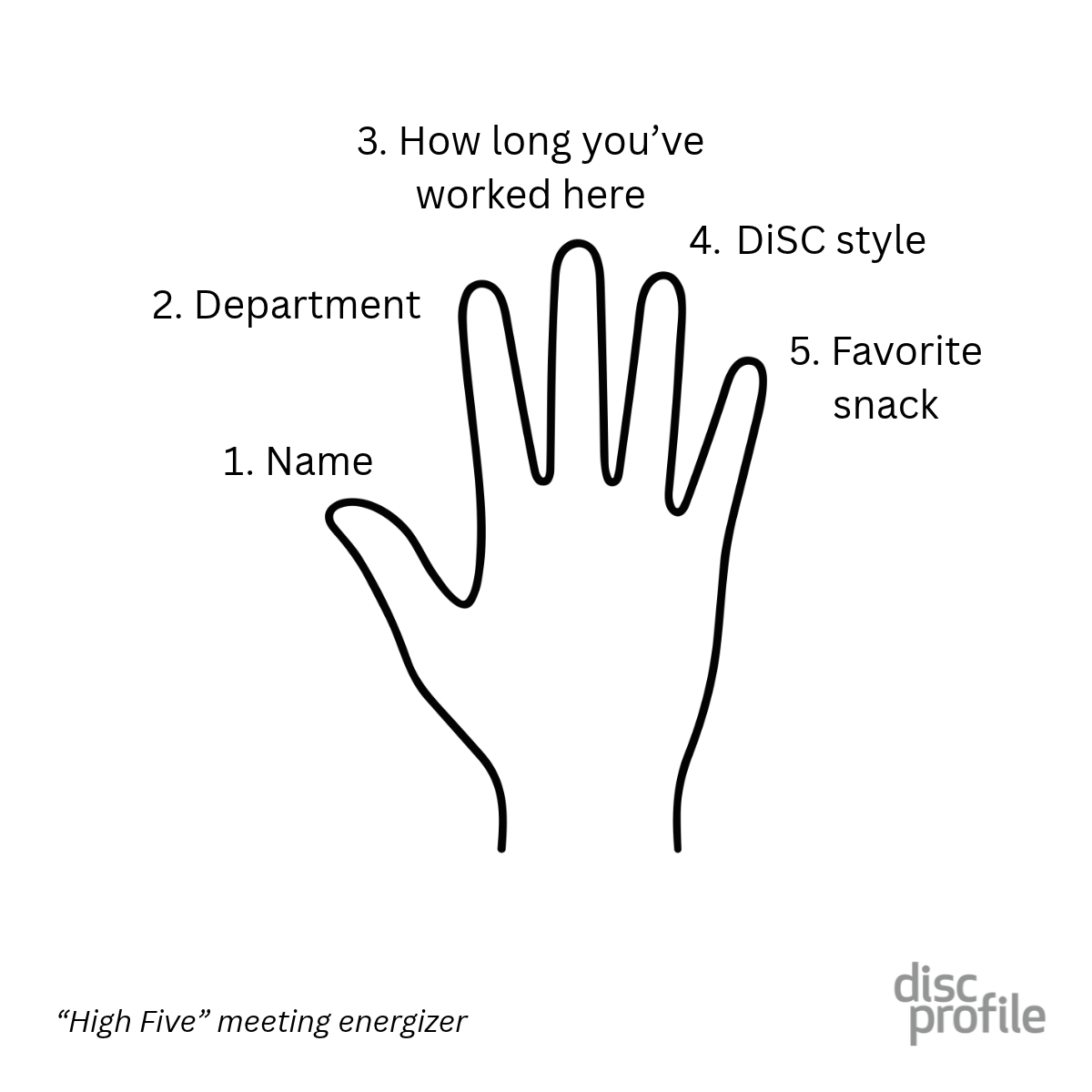
- High five. Display an image of a hand with five pieces of information (one for each finger). Have the group go around and answer, holding up their hands and pointing to each finger as they give that information (idea via University of Florida). Here’s an example image:
Creative energizers
- Origami. Show people how to fold a simple origami figure.
- Eyes-closed drawing. Have participants close their eyes and draw a scene (“where you live”), an animal (“giraffe”), or a self-portrait. Share with the group.
- How to draw a cat. Encourage freeform doodling, or put up “how to draw” instructions for a simple figure.
- Coloring pages. Classic for a reason. Here are some DiSC-themed coloring pages (PDF).
- Pairs drawing. Give a simple image to one person. They describe it to their partner, who tries to draw it just based on their description.
- Story chain. Give the group a starting sentence. Then use dice or a random number generator to select the next person. They add a sentence to the story. Repeat until everyone has contributed to the story.
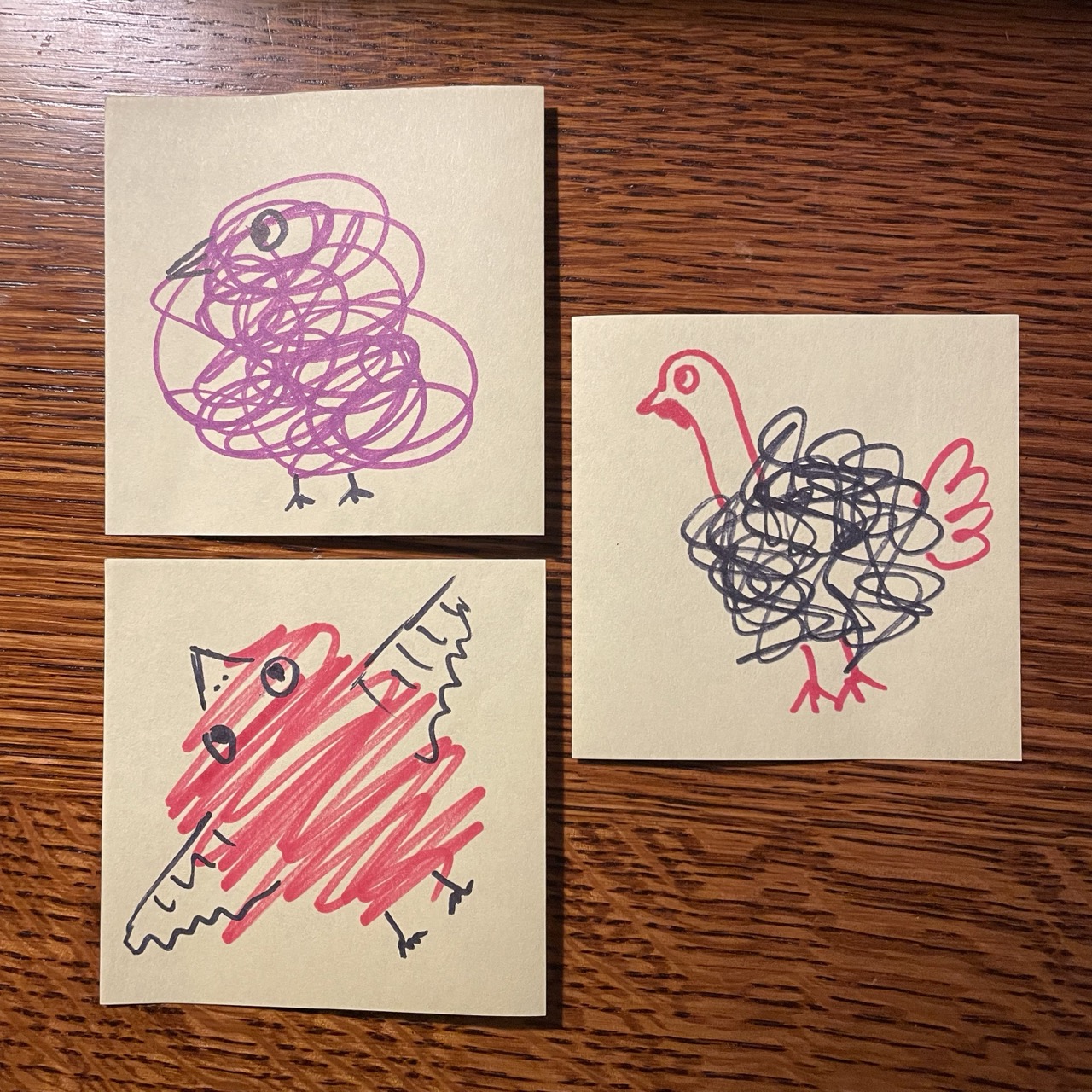
- Squiggle birds. Have people make a few quick squiggles on sticky notes, without telling them what they’re for. Then, give them a couple of minutes to turn each squiggle into a bird. Have people share their favorites.
Tips for using meeting energizers
Meeting energizers work best when they’re intentional, well-timed, and suited to the group. A little planning can make the difference between an activity that feels like a fun reset and one that feels like an awkward interruption.
Six tips for using meeting energizers
- Choose the right moment. Watch for signs that energy or attention is fading.
- Keep it short. A 2-3 minute energizer can refresh participants without derailing your agenda.
- Match the activity to the group. An activity that’s fun for one group might feel uncomfortable to a more reserved group. Consider participants’ personalities and familiarity with each other.
- Give clear instructions. Keep directions simple and direct, and demonstrate if necessary.
- Make participation low-pressure. Not everyone enjoys being put on the spot. Offer activities that allow people to participate in different ways, and avoid requiring anyone to share personal information or perform in front of the group.
- Plan your transition back to the session. Don’t let the energy boost become a distraction. Briefly acknowledge the activity and connect it to what's next. Think ahead about a simple question or phrase that can help bring the group back together.
A three-minute energizer can make a big difference in how participants feel, connect, and engage with a training session. Keep a few of these ideas in your facilitator toolkit, and you’ll always have a simple way to refresh the room and bring people back into the conversation.
Posted 11/12/2026


