


Follow-up resources for the Five Behaviors®
Follow-up resources for the Five Behaviors®
Keep developing your teams
Every training benefits from a few reminders and a chance to practice or extend the lessons learned. Here we offer a few suggestions for ways to reinforce learning and help build more cohesive teams. These could be shared with teams, team leaders, or used during another workshop.
We have free content available at The Five Behaviors® downloadable assets. These resources supplement those.
Team review
Trust
Conflict
Commitment
Accountability
Results
Team review
These questions, suggested by Julia Rozovsky at Google, can be a great review of progress. We also recommend using the Five Behaviors Progress Report.
- Can we, as a team, take a risk without feeling insecure or embarrassed?
- Can we count on each other to deliver high-quality results on time?
- Are our goals, roles, and execution plans clear?
- Are we working on something that is personally meaningful to each of us?
- Do we fundamentally believe that the work that we’re doing matters?
The Table Group suggests this activity: Team Effectiveness Exercise.
Trust
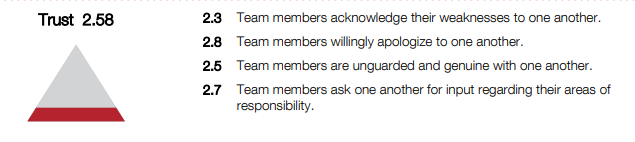
Ask the team leader to select a few ice breaker or trust-building questions to ask at the beginning of their next few meetings. Examples:
- Do you have a passion project or hobby you look forward to doing in your time off? What is it? Can you share a photo?
- What’s one skill you always have wanted to learn or improve upon?
- What was your favorite childhood toy? Or one you really wanted to get, but never did.
- What would a perfect day at work look like for you?
We also offer a Team activity to build trust.
Share:
How to Build Trust at Work, from our blog
How to build (and rebuild) trust, TED video
Conflict
Run the Five Behaviors Comparison Reports for members in conflict. See Making the Most of Comparison Reports. Offer to facilitate their discussion around the report.
Get your team set up on the Everything DiSC® on Catalyst™ platform. On Catalyst, your learners can get advice on working with specific team members or the group as a whole, including during conflict situations.
Post The Five Behaviors Conflict Map where it's easily seen or found.
Share:
7 Things to Say When a Conversation Turns Negative, HBR
The Conflict Continuum: Where Is Your Team?, from our blog
Commitment
During the Five Behaviors Team Development workshop, each team member probably wrote down a change they were committed to making and one change they wanted the team to make. Remind members of these commitments and discuss progress made on them.
Ask the team to consider cross-training programs to give members more flexibility in how they can contribute. Or create a task map to see if members' skills and interests are best aligned with team tasks.
Fill out the Team alignment canvas, by Strategy Field Guide. Ask all members if they can commit to the values and goals included in the document.
Share:
Achieving Commitment on Your Team, from our blog
Forget Consensus. Focus on Commitment, Instead., from our blog
Accountability
Accountability is often the area in which teams struggle most. There are many strategies a team can employ to improve. We offer a few resources below, based on common challenges. Teams can review one of these and discuss, making commitments to make specific changes based on what they've learned.
How to Balance Care and Accountability When Leading Remotely, Coaching for Leaders Podcast
Review the five steps of the Accountability Dial:
- The Mention
- The Invitation
- The Conversation
- The Boundary
- The Limit
Unfocused or unproductive meetings
Effective Meetings: Level 10 Meeting for Entrepreneurial Leadership Teams, video, EOS Worldwide
Tips good for more than just entrepreneurs or leadership teams.
Using DiSC for Better Meetings, from our blog
Difficulty giving feedback
The secret to giving great feedback, video, The Way We Work, a TED series
How to Actually Encourage Employee Accountability, Harvard Business Review
Giving and Receiving Feedback: Tips for Each Personality Type, from our blog
Lack of clear priorities and shared goals
Set objectives and develop key results, re:Work
How to Develop Key Performance Indicators, video by OnStrategy
No dashboards or tracking tools
We can't be held accountable for anything we're not tracking. There are numerous tools and even free templates available to make tracking easier. Choose one and review it regularly.
Best KPI Dashboard Excel Templates for All Your Needs, Geek Dashboard
Communication tool confusion
There can easily be a discrepancy between the communication tools that people find most effective and the ones they regularly use. Discuss which tools will be used, how, and when.
How to Set Communication Guidelines With Your Team, The Effective CMO
Results
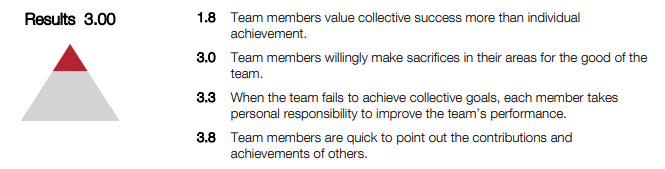
Discussion questions:
- Do you think the scores we had would be higher if we took the team assessment today?
- What does success look like? What counts as a positive result?
- How is the team recognized or rewarded for its work and outcomes?
- Are individual rewards distracting from team results?
- How can we reward each other? How are results announced and celebrated?
- If your team disbanded and had an obituary, what would it say?
Help Your Team Get Results, from our blog